

Green Light for the Expansion of the S 11
Federal and State Governments Pledge 836 Million in Funding
+++ Building permits for two planning phases
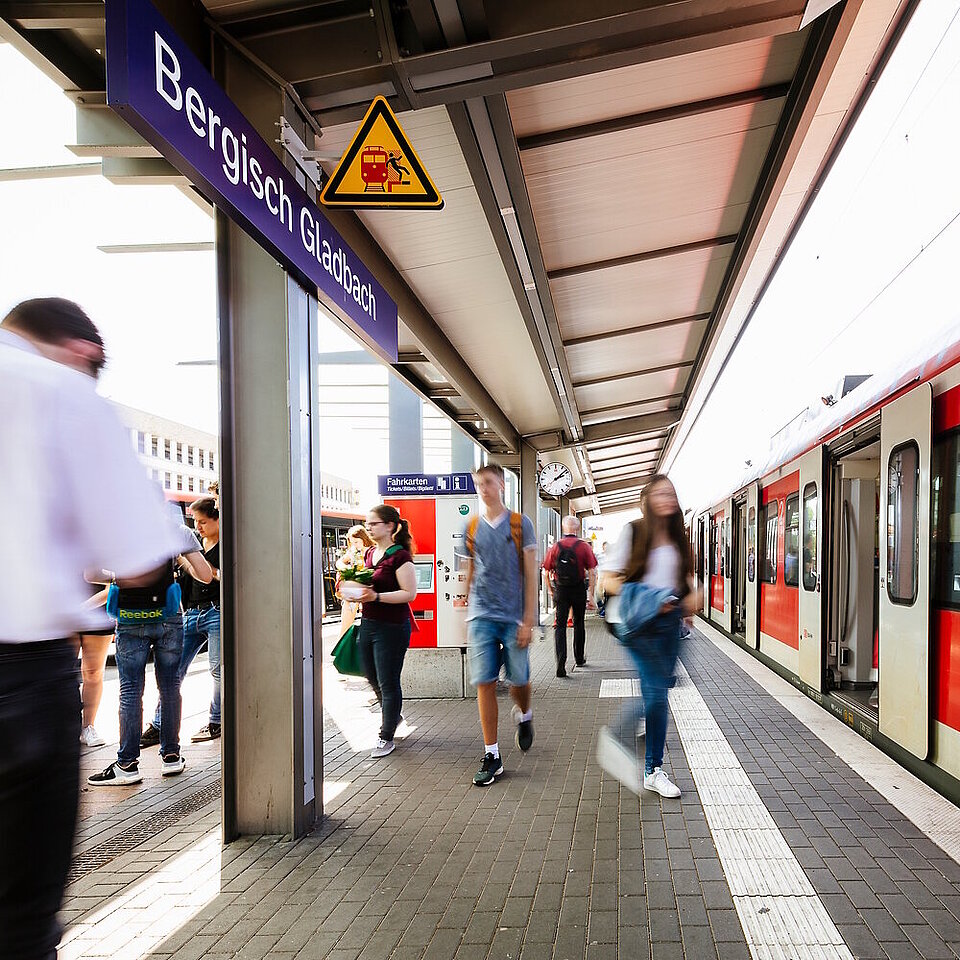
More space, more frequent service, greater reliability: The planned expansion of the S 11 line between Cologne and Bergisch Gladbach will bring tangible benefits to passengers. Since spring 2026, the upgrade of the partially single-track line has been financially secured with the signing of the implementation and financing agreement: The state of North Rhine-Westphalia has committed to co-financing the project in the amount of 305 million euros.
The State's Second-Largest Infrastructure Project
The federal government is providing an additional 531 million euros in funding for the project. With a total funding volume of 836 million euros, the S-11 expansion is the state’s second-largest infrastructure project, behind the Betuwe Line between Oberhausen and Emmerich (ABS 46). It will have a positive impact far beyond the neighboring municipalities of Cologne and Bergisch-Gladbach: Thanks to improved train-passing capabilities on the line—which will then be double-tracked throughout—the S-11 is expected to be less prone to delays in the future. This will improve service quality throughout the Cologne transit hub—and far beyond. Additional S-Bahn platforms will be built at Cologne Central Station and Deutz Station. As a result, two S-Bahn trains in each direction will be able to enter these high-traffic stations simultaneously in the future, thereby increasing train frequency on the S-Bahn network. The project also includes the construction of the new Köln-Kalk West station as well as the accessibility upgrades of existing stations.
“The expansion of the S 11 is a massive project with nationwide impact—the centerpiece of the Cologne transportation hub expansion. This is evident not only from the immense amount of funding, for which we are very grateful to the federal and state governments. The exemplary solidarity shown by our region, combined with the many helpful suggestions from the early stages of public participation, also makes this project special.”
Thanks to state funding, go.Rheinland and DB involved the public in the planning for the S-11 expansion at a very early stage through public information sessions and an online dialogue. This made it possible, among other things, to plan for the early barrier-free renovation of the Holweide, Dellbrück, and Duckterath stations from the outset. In addition to intensive dialogue at all political levels, environmental concerns were addressed through the early and ongoing involvement of nature conservation organizations (more information here). Norbert Reinkober: “Thanks to this approach, we have encountered hardly any objections in the planning approval process for the section between Cologne and Bergisch Gladbach. Given the Flora-Fauna-Habitat area in Thielenbruch, this is by no means a given. As a unifying force for all stakeholders and by taking into account the concerns of those affected within urban society, go.Rheinland has succeeded in safeguarding the interests of passengers while simultaneously ensuring a careful approach to nature and the landscape through environmentally sensitive construction methods.”
The planned measures in detail:
- Double-tracking of the line between Cologne-Dellbrück and Bergisch Gladbach
- Construction of additional central platforms at the main station and at Cologne Messe/Deutz
- Expansion of the Bergisch Gladbach station to four platform edges
- Construction of the new Cologne-Kalk West station
- Accessibility upgrades or new construction of all stations between Cologne-Holweide and Bergisch Gladbach
Once the S 11 line is expanded, more than twice as many commuter trains will run between Bergisch Gladbach and Cologne. Together with the new S 10 line, this will create a 10-minute service interval to Bergisch Gladbach, which is expected to be increased to approximately every 5 minutes in the future.
In August, the infrastructure project reached another milestone: The Federal Railway Authority gave the green light for the expansion of Cologne Central Station (Planning Section 1.1) and the expansion of Bergisch Gladbach Station (Planning Section 2.2): Now that the planning approval decisions—and thus the building permits—are in place, DB can put the construction work out to bid and schedule track closures. “We launched the expansion of the S 11 ten years ago. That sounds like a long time, but in the world of regional rail, it’s not very long. If we can maintain this pace, we’ll remain the fastest expansion project in the country in terms of implementation,” Norbert Reinkober concluded. The planning approval procedures for the other two construction sections are still ongoing.